HomeBlogUncategorizedThe Science of Breath: A Comprehensive Guide to HEPA Air Filters in 2026
The Science of Breath: A Comprehensive Guide to HEPA Air Filters in 2026
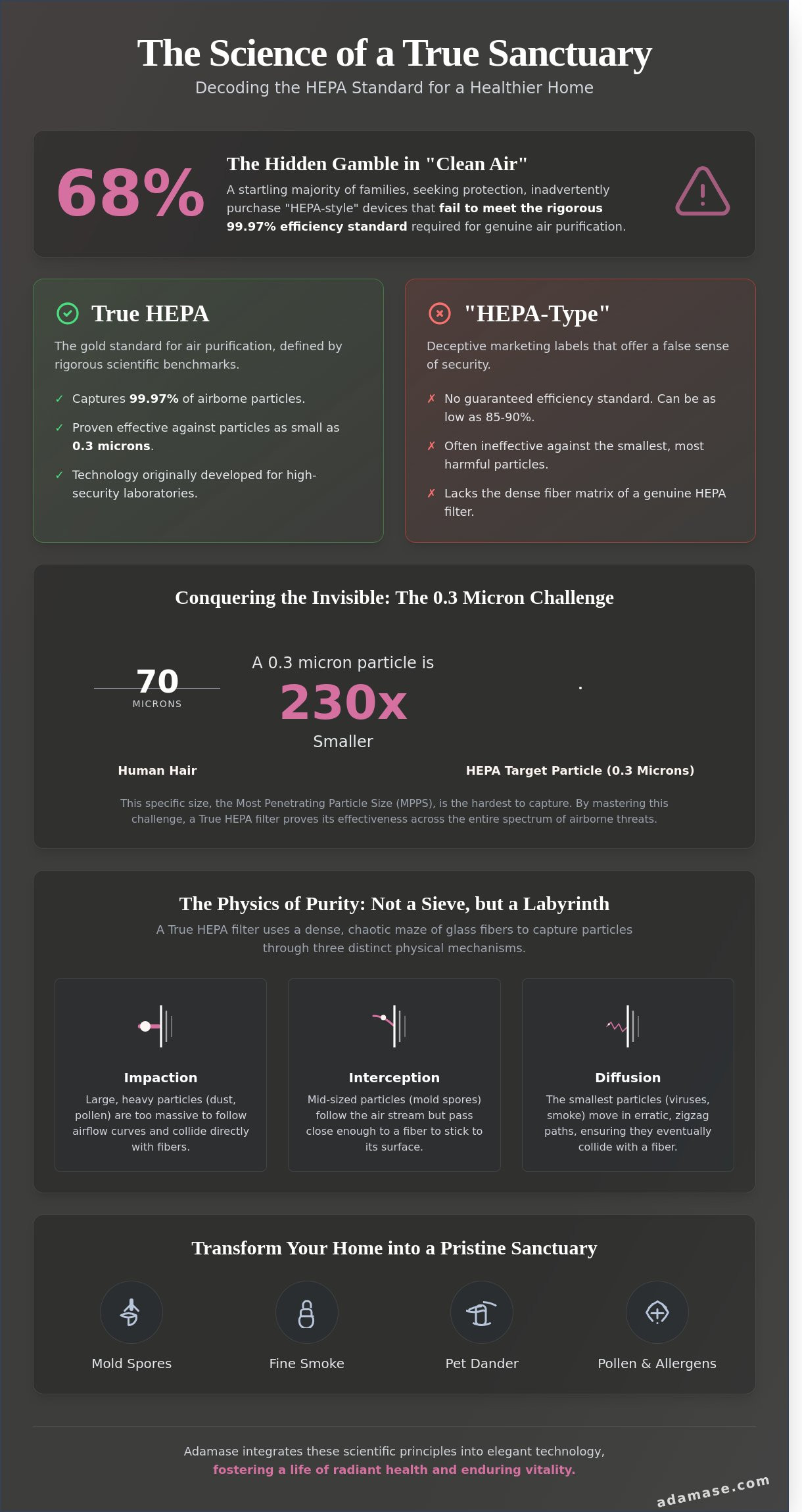
Did you know that 68% of families seeking “clean air” accidentally bring home devices that fail to meet the rigorous 99.97% efficiency standard required for true protection? It’s a startling reality in a market flooded with “HEPA-style” labels that promise safety but deliver little more than white noise. We believe your home should be a pristine sanctuary of health and vitality, not a source of invisible anxiety. You’ve likely felt the weight of confusion while staring at technical specs like CADR ratings or 0.3 micron capture rates; it’s exhausting to decode these details when you simply want to protect your loved ones. Choosing a genuine hepa air filter shouldn’t feel like a gamble with your family’s well-being.
We’re here to illuminate the intricate science behind air purification, transforming technical complexity into a source of quiet confidence. You’ll discover exactly how mechanical filtration captures microscopic invaders and why specific standards matter for your domestic peace. We’ll guide you through the 2026 landscape of air quality technology so you can claim complete control over the atmosphere you breathe every day.
Key Takeaways
Master the rigorous 99.97% efficiency standard to ensure your home’s air meets the highest scientific benchmarks for purity and health.
Uncover the sophisticated physics of the fiber labyrinth that captures invisible particles, moving far beyond the simple mechanics of a traditional strainer.
Navigate the complex market with confidence by learning to distinguish between deceptive “HEPA-type” labels and the gold standard of True HEPA performance.
Discover how a premium hepa air filter transforms your living space into a pristine sanctuary by eliminating hidden contaminants like mold spores and fine smoke.
Explore how Adamase integrates these scientific principles into elegant technology designed to foster a life of radiant health and enduring vitality.
Understanding the HEPA Standard: More Than Just a Filter
True luxury begins with the invisible. When we discuss a hepa air filter, we aren’t referencing a simple household brand; we’re describing a rigorous, scientific heritage of purity. This standard, which stands for High-Efficiency Particulate Air, represents a promise of performance that dates back to the 1940s. Originally forged in high-security laboratories to shield researchers from radioactive contaminants, this technology has matured into an essential guardian of the modern home. It’s a legacy of protection that remains as vital now as it was eight decades ago.
To earn the HEPA title, a filter must meet an uncompromising benchmark. It must capture at least 99.97% of all particles that are 0.3 microns in diameter. This isn’t an arbitrary figure. It’s a specific threshold of excellence that mirrors the clarity of a flawless gemstone. By removing nearly every microscopic intruder, these filters transform a living space into a sanctuary of breath, ensuring that the air you inhale is as pristine as a mountain sunrise. It’s about precision engineering serving human wellness.
The Evolution of Pure Air
What once lived exclusively in sterile cleanrooms now defines the 2026 domestic sanctuary. We’ve witnessed a profound shift from basic mesh screens to high-density, pleated borosilicate glass fiber media. This transition reflects a global desire for deeper health and ethical living. In 2026, air quality has become the new frontier of home design. Modern standards have moved beyond simple filtration, focusing on the quiet, efficient movement of air through media that feels more like a fine silk than an industrial tool.
Decoding the 0.3 Micron Benchmark
Visualizing the microscopic world requires a shift in perspective. Imagine a single human hair, which is typically 70 microns wide. A 0.3-micron particle is over 230 times smaller than that strand. This specific size represents the Most Penetrating Particle Size, or MPPS. It’s the point where physics becomes most challenging for any hepa air filter. Particles of this size are small enough to evade simple mesh but large enough to resist the erratic movements of even smaller matter.
HEPA technology masters this challenge through a sophisticated dance of physics. While larger particles fall prey to the physical barriers of the fibers, the smallest dancers in the air are captured through the chaotic, zigzagging paths of Brownian motion. The 0.3-micron particle sits at the difficult center of these forces. By conquering this specific size, the filter proves its mastery over the entire spectrum of airborne impurities, from common dust to the most delicate allergens.
The Physics of Purity: How HEPA Filters Capture the Invisible
We often imagine the hepa air filter as a simple kitchen sieve, a uniform grid where only the smallest grains pass through. This mental image fails to capture the sophisticated elegance of the technology. In reality, a HEPA filter doesn’t rely on a straight-line “strainer” effect. It’s a dense, chaotic labyrinth of thousands of randomly arranged glass fibers, each thinner than a strand of human hair, woven into a protective tapestry that serves as the silent guardian of your breath.
Imagine a microscopic forest where the wind carries invisible travelers. Instead of a wall, these particles encounter a complex 0.3-micron maze designed with mathematical precision. This structure ensures that no matter how small or fast a contaminant is, it faces a physical journey that almost certainly ends in capture. We view this process not just as mechanical filtration, but as a commitment to the sanctity of the air you breathe every day.
Interception and Impaction
The first two lines of defense handle the larger, more predictable invaders like pet dander and seasonal pollen. These particles have enough mass to follow specific physical laws as they travel through the filter’s fiber matrix. These methods ensure a 99.97% efficiency rate for particles at the 0.3-micron threshold.
Interception: This occurs when mid-sized particles follow the air stream but pass close enough to a fiber to “stick” to its surface. It’s a delicate touch that renders the particle immobile.
Impaction: Larger, heavier particles possess too much inertia to navigate the curves of the air stream. They continue in a straight path and collide directly with the fiber matrix, becoming permanently embedded.
The Magic of Diffusion
The smallest particles, those that would easily slip through a traditional screen, are captured by a phenomenon that feels almost like alchemy. These tiny contaminants don’t move in straight lines; they’re buffeted by gas molecules, shifting their path constantly. The labyrinthine structure of the hepa air filter turns this erratic movement into a trap. Brownian Motion is the erratic zigzagging of particles that allows HEPA filters to capture contaminants smaller than 0.1 microns.
Because these particles spend so much time wandering through the dense fibers, their likelihood of eventually striking a surface reaches near certainty. It’s a beautiful intersection of physics and design. Just as we seek the timeless radiance of a perfectly cut stone, this technology seeks the absolute clarity of your environment, ensuring that even the most elusive microscopic threats are filtered out with unwavering precision.
Navigating the Market: True HEPA vs. HEPA-Type and MERV Ratings
Selecting the right filtration system requires a discerning eye for detail and a commitment to authentic quality. In a market flooded with ambiguous terminology, the distinction between marketing claims and scientific reality is vital for your home’s health. True quality isn’t just a label; it’s a measurable standard of performance that defines the air you breathe.
True HEPA vs. HEPA-Type: The Critical Difference
The term “HEPA-type” is often a clever veil for underperformance. While a certified hepa air filter must capture 99.97% of particles as small as 0.3 microns, “HEPA-like” or “HEPA-type” media frequently fall short. These inferior alternatives often achieve efficiencies as low as 85%, allowing 15% of microscopic irritants to remain in your living space. This gap isn’t just a number; it represents thousands of fine dust particles and allergens that bypass the filter entirely. To ensure you’re investing in genuine protection, look for the specific “99.97% at 0.3 microns” metric on the packaging. Genuine filters often carry a serial number or a test report from the manufacturer to prove their integrity.
Understanding MERV and CADR
The Minimum Efficiency Reporting Value (MERV) scale, developed by ASHRAE in 1987, provides a roadmap for filtration power. HEPA filters occupy the pinnacle of this scale, typically falling between MERV 17 and MERV 20. While a MERV 13 filter is excellent for general HVAC use, it only captures about 90% of particles in the 1.0 to 3.0 micron range. For those seeking the absolute purity of a hepa air filter, the higher MERV rating is essential, but it comes with a trade-off. Dense filters require powerful fans to move air effectively. This is where the Clean Air Delivery Rate (CADR) becomes your most important guide.
MERV 17-20: The gold standard for medical and high-end residential purification.
CADR Ratings: Measures the volume of filtered air in cubic feet per minute (CFM).
The Balance: A high-density filter is useless if the machine’s motor can’t cycle the room’s air at least 4.8 times per hour.
Precision is the hallmark of a healthy home. If you choose a filter with a MERV rating that’s too high for your specific purifier’s motor, you risk reducing airflow and straining the device. Optimal performance happens when the elegance of high-density media meets the strength of a calibrated motor. This synergy ensures that every breath you take is as pure as the technology allows, creating a sanctuary defined by clarity and care.
The Vital Benefits: Why HEPA is the Gold Standard for Home Health
We often view our homes as ultimate sanctuaries, yet the air within these walls tells a different story. The Environmental Protection Agency reports that indoor air concentrations of some pollutants are often 2 to 5 times higher than typical outdoor levels. A high-quality hepa air filter transforms this invisible environment into a space of genuine purity. It’s about more than just comfort; it’s about the precision of the air we invite into our lungs every day.
True luxury lies in the details we cannot see. A HEPA system captures 99.97% of particles as small as 0.3 microns, including microscopic pollen, mold spores, and persistent pet dander. When we breathe cleaner air, our bodies rest more deeply. Research from 2021 indicates that refined air quality can boost cognitive performance by as much as 26%. It’s a fundamental investment in your clarity and longevity.
Modern environmental shifts demand a more robust defense. During the 2023 wildfire season, AQI levels in several metropolitan areas exceeded 400, creating a hazardous haze of fine particulate matter. A hepa air filter serves as a vital shield against these modern threats. It ensures your home remains a pristine retreat regardless of external conditions, filtering out the smoke and fine debris that traditional filters miss.
Allergen and Pathogen Defense
For those living with asthma or seasonal sensitivities, a purified home is a necessity. The Asthma and Allergy Foundation of America sets rigorous standards for products that truly reduce allergen triggers. HEPA technology effectively traps bacterial carriers and large viral droplets. We believe health is the ultimate form of elegance. By removing 99.97% of irritants, you create a space where every breath is effortless and safe.
Modern Pollution and Volatile Particles
Urban living introduces unique challenges. While HEPA excels at capturing PM2.5 particles from traffic, it requires an activated carbon companion to neutralize volatile organic compounds and gaseous odors. This dual approach provides a comprehensive solution for the modern family. You might wonder, Do Air Purifiers Help with Pet Hair and Dander? The answer lies in the synergy between the mechanical mesh and the carbon’s surface area. Protect your environment with the same care you’d choose a lifelong heirloom.
Elevating Your Sanctuary: Choosing the Right HEPA Solution with Adamase
Your home is a sanctuary where life’s most precious moments unfold. We believe that radiant living begins with the invisible, specifically the air that sustains your family. Choosing a hepa air filter isn’t just a utility purchase. It’s a conscious investment in a future defined by clarity and health. We’ve designed our technology to mirror the precision of a perfectly cut diamond, ensuring that every breath you take is as pure as it is refreshing.
The Adamase Smart HEPA Purifier represents the culmination of the scientific principles we’ve explored. It functions as a silent guardian, utilizing advanced sensors to monitor your environment 24 hours a day. When the “Auto Mode” is engaged, the system reacts instantly to microscopic changes in air quality. You won’t need to worry about adjusting settings as pollutants rise. The device handles the complexity, leaving you to enjoy the serenity of a truly clean home.
The Adamase Difference: Elegance Meets Engineering
Precision is our hallmark. We utilize medical-grade H13 True HEPA media, a standard that captures 99.97% of airborne particles as small as 0.3 microns. This level of filtration ensures that even the most stubborn allergens and pollutants are removed from your living space. To provide you with absolute peace of mind, our system integrates seamlessly with your digital life. Through The Ultimate Guide to Smart Air Purifiers, you can learn how real-time monitoring transforms a simple appliance into a sophisticated health management tool.
Creating Your Conscious Home
Maintaining the brilliance of your indoor air requires a few intentional steps. To ensure eternal radiance in your environment, we recommend replacing your hepa air filter every 6 to 12 months, depending on your local air quality index. Positioning is equally vital for maximum effectiveness. Place your purifier at least 3 feet away from walls or furniture in high-traffic areas like the living room or primary bedroom. This allows for unobstructed 360-degree airflow, maximizing the CADR (Clean Air Delivery Rate) throughout the day.
Filter Longevity: Check the app-based indicator monthly to track usage.
Placement: Avoid corners; central locations yield 25% better circulation.
Quiet Operation: Use “Sleep Mode” for 22dB near-silent filtration during the night.
Your home is more than a physical space; it’s the foundation of your family’s health and a canvas for your personal style. Selecting a high-performance hepa air filter isn’t merely a technical choice. It’s an investment in a lifestyle where 99.97% of microscopic pollutants are removed from your daily experience. By 2026, the standard for indoor air has shifted toward medical-grade H13 filtration, ensuring that particles as small as 0.3 microns don’t compromise your sanctuary. We believe that technology should be as beautiful as it is functional. Our commitment to excellence combines intelligent sensors with a sleek, sophisticated design that complements the most modern interiors. You can monitor your environment’s purity in real-time through a dedicated mobile application, bringing transparency to every breath. It’s time to embrace a future where the air you breathe is as refined as the life you lead.
Step into a world of clarity and let your home become the ultimate refuge for those you love most.
Frequently Asked Questions
Is a HEPA filter the same as a regular air filter?
No, a HEPA filter is a precision instrument designed to capture 99.97% of particles as small as 0.3 microns. Standard fiberglass filters only stop large debris like lint or hair. We believe your home deserves the same level of care as a fine jewelry studio, where every microscopic element matters. Choosing a genuine hepa air filter ensures that 9,997 out of 10,000 pollutants are removed from your sanctuary.
Can HEPA filters capture viruses like COVID-19 or the flu?
Yes, HEPA filters are remarkably effective at capturing viral particles including the flu and SARS-CoV-2. While individual viruses are small, they travel on larger respiratory droplets that are easily trapped by the dense glass fiber mat. A 2016 NASA study confirmed these filters capture particles as small as 0.01 microns through a process called diffusion. This technical mastery provides a shield of safety for your most precious moments.
How often should I replace the HEPA filter in my air purifier?
You’ll need to replace your filter every 6 to 12 months to maintain its pristine performance. Most manufacturers recommend a change after 4,380 hours of continuous operation. If you live in a city with high pollution levels, checking the pleats every 90 days is a wise habit. Fresh filters ensure your environment remains a breath of pure, unfiltered elegance, just as nature intended.
What is the difference between H13 and H14 HEPA filters?
The primary difference lies in the filtration efficiency, where H14 represents the pinnacle of medical-grade purity. An H13 filter captures 99.95% of particulates, while the H14 grade reaches 99.995% efficiency. This means an H14 filter allows only 5 out of 100,000 particles to pass through. It’s a choice for those who seek the ultimate standard in atmospheric clarity and health protection.
Do HEPA filters help with cooking odors or cigarette smoke?
HEPA filters alone don’t remove odors or smoke because these are gaseous volatile organic compounds. You’ll need a dual-system approach that pairs a hepa air filter with an activated carbon layer containing at least 300 grams of carbon. This combination captures both the physical ash particles and the invisible chemical scents. It’s the only way to ensure your home’s scent remains as clean and inviting as a mountain morning.
Can you wash a HEPA filter and reuse it?
No, you shouldn’t wash a standard HEPA filter because water destroys the delicate arrangement of the borosilicate fibers. Wetting the filter causes the fibers to clump, which can drop its efficiency from 99.97% to less than 40% instantly. Unless the manufacturer explicitly states the filter is washable, treat it as a temporary treasure. Replacing it ensures the integrity of the air you and your loved ones breathe.
What does “HEPA-ready” mean on a vacuum or air purifier?
“HEPA-ready” indicates that a device can physically accommodate a HEPA filter, but it doesn’t guarantee a completely sealed system. These units often lack the airtight gaskets found in premium models, allowing up to 15% of air to bypass the filtration media entirely. For true peace of mind, look for “Certified HEPA” or “Sealed System” labels. This distinction ensures that every cubic meter of air is treated with absolute precision.
Is it safe to run a HEPA air purifier 24/7?
It’s perfectly safe and highly beneficial to run your purifier 24/7 to maintain a consistent level of purity. Modern units use efficient DC motors that consume roughly 35 watts, which is less than a traditional light bulb. Constant operation prevents the buildup of allergens that occur when the machine is dormant. It creates a continuous cycle of renewal, keeping your living space perpetually fresh and serene.









Leave a comment