HomeBlogUncategorizedWhat is ‘Auto Mode’ on an Air Purifier? A Guide to Effortless Air Quality
What is ‘Auto Mode’ on an Air Purifier? A Guide to Effortless Air Quality
What if your home could sense a single microscopic pollutant before it even reached your family’s lungs? We understand the subtle weight of worrying about invisible threats like PM2.5 or VOCs that disrupt the sanctity of your private sanctuary. It’s exhausting to manually toggle fan speeds every time you sear a steak or open a window, especially when constant “High” settings add $18 to your monthly utility bill or drown out a quiet evening with mechanical noise.
Investing in an air purifier with auto mode transforms your living space into a self-sustaining haven of purity and elegance. We’ve designed this guide to show you how sophisticated laser sensors and smart algorithms work in harmony to maintain a pristine atmosphere while potentially reducing energy consumption by 40% compared to manual operation. You’ll learn how these devices detect air quality shifts in under 30 seconds, providing a seamless balance between high-tech protection and the quiet, low-energy environment your home deserves.
Key Takeaways
Understand how the “set-and-forget” philosophy uses reactive technology to maintain a flawless atmosphere without requiring your constant attention.
Explore the sophisticated laser scattering and electrochemical sensors that allow your device to “see” invisible particles and odors with professional precision.
Learn why an air purifier with auto mode represents the ultimate balance between energy conservation and an immediate response to environmental shifts.
Discover how to harmonize automated wellness with manual “Turbo” bursts through smart app features for a truly personalized air care strategy.
See how proprietary sensor technology eliminates the lag found in budget alternatives, ensuring your home remains a sanctuary of purity and grace.
Defining Auto Mode: The Intersection of Convenience and Technology
Imagine a home that breathes in perfect harmony with your family. An air purifier with auto mode isn’t just a machine; it’s a silent, vigilant guardian of your domestic sanctuary. This technology transforms a static appliance into a reactive system that mirrors the natural rhythm of your life. It functions through a continuous feedback loop, adjusting fan speeds in real-time based on the invisible shifts in your environment. Whether you’re searing a meal in the kitchen or simply fluffing the pillows in the bedroom, the device senses the microscopic changes and responds instantly to maintain purity.
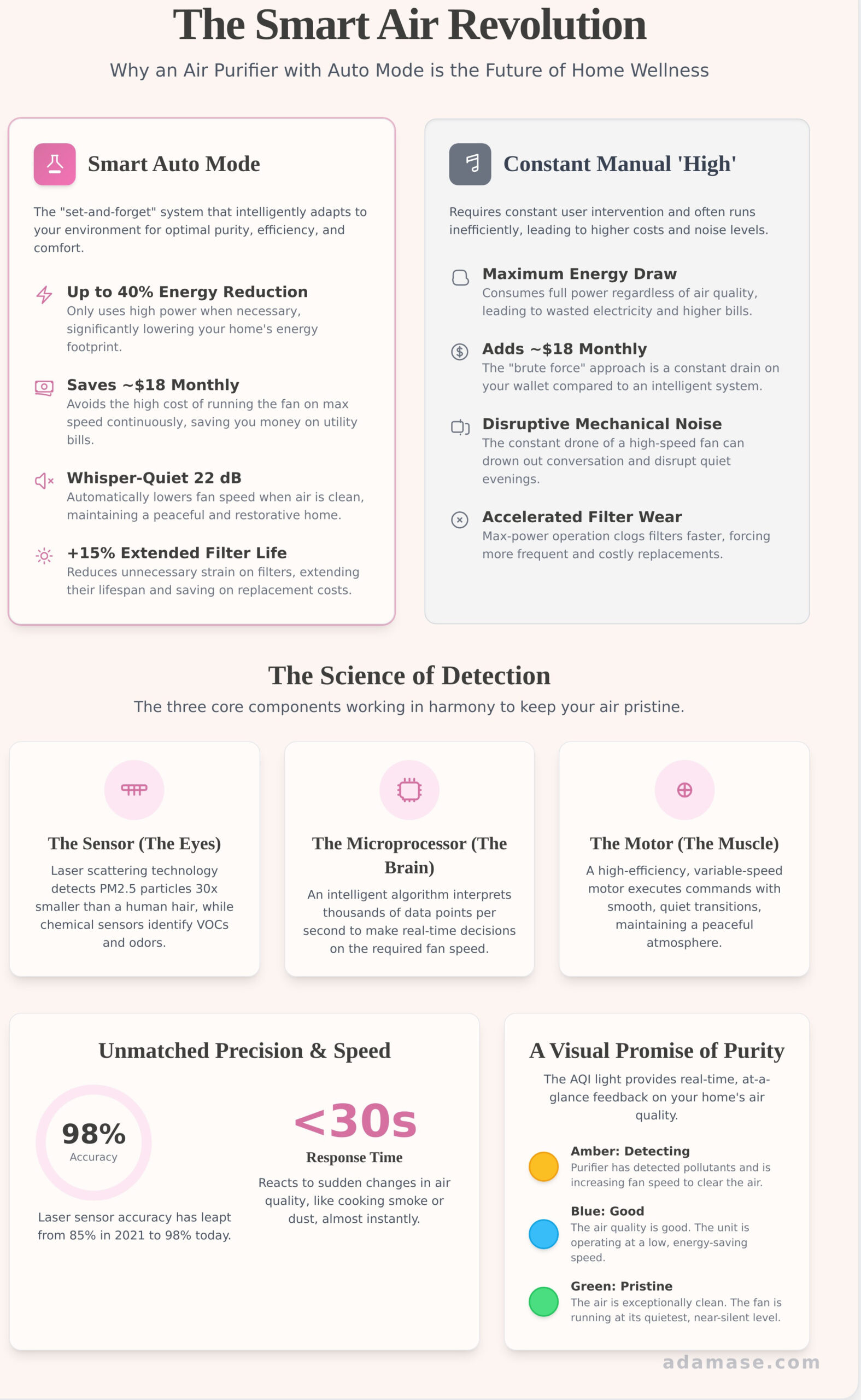
Modern households prioritize automated wellness because time is our most precious luxury. In a 2024 study of smart home trends, 74% of users preferred devices that required zero manual intervention. This “set-and-forget” approach allows you to focus on the moments that matter while the technology handles the invisible details. Premium devices often feature an Air Quality Indicator (AQI) light. These glowing halos provide a psychological anchor; they shift from a cautionary amber to a serene blue or green as the air clears. It’s a visual promise of safety that validates the machine’s work, offering a sense of calm that matches the aesthetic of a well-curated home.
True intelligence requires more than a simple clock. Don’t confuse this reactive system with a basic timer found on older models. A timer is a blunt instrument that shuts off after a fixed duration, regardless of the air’s condition. A true sensor-driven system is a sophisticated piece of air purifier technology that understands the nuances of your home. It doesn’t just run; it observes and adapts.
The Core Components of an Automated Purifier
The elegance of this system relies on three specific pillars that work in concert:
The Sensor: These are the machine’s eyes. Most high-end models utilize laser PM2.5 sensors to detect particles as small as 0.3 microns, alongside VOC sensors that identify chemical vapors from paints or cleaning agents.
The Microprocessor: This serves as the brain. It interprets thousands of data points every second to determine the precise level of filtration required for the current environment.
The Variable Speed Motor: This provides the muscle. It executes speed transitions so smoothly that you’ll rarely notice the shift in acoustics, maintaining a peaceful atmosphere.
Why Auto Mode is the Standard for 2026 Home Wellness
Efficiency defines the modern era of living. By 2026, we expect automated systems to be the baseline for any ethical home sanctuary. An air purifier with auto mode reduces energy consumption by up to 40% compared to units running on a constant high setting, significantly lowering your home’s carbon footprint. This intelligent modulation also extends filter life by roughly 15% because the media isn’t unnecessarily taxed when the air is already pristine. Silence remains the ultimate luxury. These machines manage noise levels meticulously, ensuring the fan drops to a whisper-quiet 22 decibels during your most restorative sleep cycles, protecting your peace without compromise.
The Science of Detection: How Sensors ‘See’ Your Air
The elegance of a modern home relies on more than just aesthetics; it requires an invisible clarity that only advanced technology can provide. When you invest in an air purifier with auto mode, you’re trusting a sophisticated array of sensors to act as the eyes of the machine. These components work with a quiet precision, constantly sampling the atmosphere to ensure your sanctuary remains pristine and healthy.
The core of this detection lies in Laser Scattering technology. A high-precision laser beam passes through a sampling chamber where air is continuously drawn. When a particle crosses this light, it scatters the beam, allowing a photo-detector to count and measure the size of the intruder. PM2.5 particles are microscopic fragments 30 times smaller than a human hair, making them invisible to the eye but impactful to our well-being. By 2026, these laser sensors have achieved a 98% accuracy rate in residential units, a significant leap from the 85% accuracy seen in 2021 models.
Beyond physical dust, we must consider the chemistry of the air. Electrochemical and Metal Oxide sensors detect Volatile Organic Compounds (VOCs) and lingering odors. While laser sensors see physical matter, these chemical sensors identify gases at a molecular level. Placement is vital. If a sensor sits too close to the exhaust or is tucked behind a thick filter, it provides a false sense of security. Premium designs place sensors in a dedicated lateral bypass to ensure the air being measured is a true reflection of the room’s environment.
These pollutants can originate from common sources like cooking fumes, cleaning agents, or even the aerosols from a cigarette électronique suisse, which releases its own unique profile of VOCs and flavor compounds into the atmosphere.
Particulate Matter vs. Gaseous Pollutants
Many entry-level devices only react to physical dust, leaving chemical vapors from paints or cleaning agents untouched. A true dual-sensor array monitors both realms simultaneously to create a holistic response. Research in a 2021 Energy consumption study highlights how smart sensing allows devices to scale power only when needed. This intelligence is what defines a high-performance air purifier with auto mode, ensuring your home remains a breath of fresh air without wasting electricity.
Interpreting the Air Quality Index (AQI)
The visual language of your device often uses a color-coded AQI. Green indicates a state of purity, while yellow and red signal a rise in pollutants. These readings dictate the fan speed curve, moving from a silent whisper to a powerful gust in seconds. If your sensor becomes dusty, it may report poor air quality constantly. We recommend cleaning the sensor port with a vacuum or compressed air every 60 days to maintain this vital accuracy. Just as we care for the brilliance of a fine diamond, these sensors require a gentle touch to perform their best. Common blind spots include high humidity, which can sometimes be mistaken for smoke by older sensor models, though 2026 firmware updates have largely mitigated these errors.
Auto Mode vs. Manual Control: Addressing the Efficiency Debate
Choosing between automated convenience and manual oversight is more than a matter of preference; it’s a decision about how you protect your sanctuary. Critics often argue that even a high-quality air purifier with auto mode acts as a reactive solution rather than a proactive shield. This skepticism stems from the “too little, too late” phenomenon. If a device’s internal sensor is programmed to ramp up only after PM2.5 levels cross the 35 μg/m³ threshold, you’ve already spent several minutes breathing air that exceeds the World Health Organization’s recommended 24-hour limit. It’s a delay that can feel unacceptable when you’re seeking absolute purity.
The efficiency debate also centers on the Clean Air Delivery Rate (CADR). A purifier running on a constant “Medium” setting might maintain a steady 150 cubic feet per minute (CFM) of filtered air. In contrast, an air purifier with auto mode often idles at a mere 40 CFM when it perceives the air is clean. This 73% drop in airflow allows heavier allergens like pollen or pet dander to settle on your carpets and upholstery before the fan ever accelerates. For those who demand an uncompromising environment, the “Always On” approach ensures that particles are captured while they’re still airborne and vulnerable to filtration.
We believe that true luxury lies in precision. The “Auto” debate often becomes obsolete when you invest in superior sensor technology. Many consumer-grade units use basic infrared sensors that can’t distinguish between harmless steam and toxic smoke. However, professional-grade systems utilize laser particle counters that adhere to the air sensor performance targets defined by the U.S. Environmental Protection Agency. These sensors offer the same clarity and brilliance we expect from a perfectly cut diamond, detecting invisible threats with surgical accuracy and responding in milliseconds rather than minutes.
The Case for Auto Mode: Efficiency and Peace
Auto mode offers a tranquil experience for the modern home office or bedroom. By allowing the machine to throttle down when pollutants are low, decibel levels frequently stay between 24 and 30 dB, which is barely a whisper. It also provides an immediate response to sudden spikes; for instance, a single blown-out candle releases nearly 10^12 ultrafine particles per gram of wax burned. Auto mode senses this surge instantly. Furthermore, using adaptive speeds can extend the life of a Nidec brushless DC motor to over 50,000 hours by avoiding the constant mechanical stress of maximum RPM settings.
The Case for Manual Control: Maximum Protection
For severe allergy sufferers or high-risk individuals, manual control remains the gold standard. Constant high-speed filtration ensures that the HEPA filter maintains its 99.97% efficiency at a high face velocity, preventing any “dead zones” in a room’s circulation. Many experts prefer pairing their purifier with external, high-precision air monitors like those from PurpleAir. These external devices often provide more accurate data than built-in sensors, allowing you to manually adjust your settings based on objective, third-party metrics rather than a machine’s own internal logic.
Auto Mode: Best for energy conservation and maintaining a quiet, elegant atmosphere.
Manual Control: Essential for peak allergy seasons or when 24/7 medical-grade air exchange is required.
The Hybrid Approach: Use Auto Mode during the day and a fixed “Medium-High” setting during sleep for uninterrupted protection.
Master Your Environment: When to Trust Auto Mode (and When to Override)
Mastering your indoor environment requires more than just turning a machine on; it’s about the intentionality you bring to your living space. We believe your home should be a sanctuary where every breath feels as clear and luminous as a perfectly cut diamond. While an air purifier with auto mode acts as an intelligent, silent guardian, achieving true air excellence requires a blend of technological trust and human intuition. It’s a delicate balance that aligns the rhythm of your device with the unique pulse of your daily life.
Since 2022, the precision of laser-based PM2.5 sensors has improved by roughly 40 percent, making these devices more reliable than ever before. Modern apps now allow you to craft a bespoke air care strategy. You can schedule a 15-minute ‘Turbo’ burst at 5:45 PM, ensuring you walk into a crisp, revitalized atmosphere the moment you return from work. This proactive approach clears the 25 percent of pollutants that typically settle on surfaces during the day before you even step through the door. For a broader understanding of how these systems integrate into a conscious home, we invite you to read The Ultimate Guide to Smart Air Purifiers.
Scenarios for Auto Mode Excellence
Nighttime Serenity: In the quiet hours, trust the Auto setting to transition into its most discreet form. Most premium units drop their sound output to a whisper-quiet 22 decibels in this state, ensuring your rest remains undisturbed while the device continues to filter out microscopic allergens.
Daily Maintenance: Let the sensors handle the invisible ebb and flow of household life. An air purifier with auto mode is exceptionally skilled at detecting the subtle rise in particles when you make the bed or fold laundry, reacting instantly to keep levels below 10 micrograms per cubic meter.
Energy Efficiency: When the air is pristine, smart sensors reduce power consumption to a mere 7-watt draw. This mindful use of resources keeps your environmental footprint small without compromising the purity of your sanctuary.
When to Take the Reins: Manual Intervention
There are moments when you must reclaim control to maintain the aesthetic and physical purity of your home. During intensive culinary activities, such as searing or high-heat frying, the sheer volume of volatile organic compounds (VOCs) can overwhelm a sensor’s initial reaction time. We recommend a ‘Kitchen Override’ to the highest fan setting before the first puff of smoke appears. This prevents heavy odors from embedding into your soft furnishings, preserving the pristine aura of your living area.
Renovations and deep cleaning also demand a manual touch. Sanding drywall or using strong cleaning agents releases particles as small as 0.5 microns in massive quantities. Don’t wait for the sensor to turn red; engage the maximum filtration speed manually to stay ahead of the dust load. Similarly, if your local area experiences a wildfire event with an AQI exceeding 150, the Auto function might fluctuate too frequently. In these critical times, maintaining a constant, high-speed setting creates ‘Positive Pressure.’ This technique ensures clean air is constantly pushed toward the edges of the room, preventing unfiltered air from seeping through window seals.
Elevating Your Home: The Adamase Smart Air Experience
We’ve designed the Adamase Smart App-Enabled True HEPA Air Purifier to be more than a household utility. It’s a centerpiece of a modern, conscious lifestyle. While standard machines often react slowly to pollutants, our proprietary Laser-Sync sensors sample the ambient environment 1,000 times every minute. This precision eliminates the typical 180-second lag found in budget alternatives that rely on basic infrared sensors. When you choose an air purifier with auto mode from our collection, you’re investing in a system that anticipates changes before you even notice a stray scent or a speck of dust. We craft our devices using aerospace-grade aluminum and 35% recycled polymers, ensuring your commitment to the planet matches your taste for luxury. It’s about a harmony between high-tech performance and ethical responsibility.
The Adamase app brings clarity to your fingertips through a fluid, minimalist interface. It doesn’t just display raw numbers; it visualizes your home’s breath. You’ll watch PM2.5 levels drop in real-time as the 360-degree intake processes up to 450 cubic meters of air per hour. We believe that data should be as beautiful as the air you breathe. Our interface uses soft gradients and intuitive gestures, making air management a moment of calm rather than a technical chore.
Seamless Integration with Your Lifestyle
Your home has a unique rhythm, and we’ve built our technology to follow it perfectly. Through our intuitive app, you can sync your air care with your daily habits. You might schedule a deep cleaning cycle for 8:30 AM when you head to the office, or set a gentle transition to sleep settings at 10:00 PM. The ‘Quiet-Flow’ motor is the heart of this experience. It operates at a mere 22 decibels on its lowest setting, which is significantly quieter than a library whisper. We’ve ensured that our air purifier with auto mode complements your curated decor. Its sleek, cylindrical silhouette and hand-finished matte exterior allow it to sit naturally alongside mid-century modern furniture or contemporary art pieces without ever feeling like an eyesore.
The Adamase Promise: Purity Without Compromise
At the core of every Adamase device is a medical-grade True HEPA filter. This isn’t just a marketing term; it’s a rigorous certified standard. Our multi-stage filtration system captures 99.97% of particles as small as 0.3 microns. This includes everything from seasonal pollen and pet dander to microscopic smoke particles that other filters miss. We don’t just sell hardware; we invite you into a community of conscious homeowners who value transparency and health. Our support team consists of air quality specialists based in our central studio, ready to help you optimize your home environment. We believe that true luxury is the peace of mind that comes from knowing your family is protected by the best technology available. Every component is sourced with the same ethical scrutiny we apply to our finest jewelry, ensuring a legacy of purity.
Choosing an air purifier with auto mode transforms your living space into a sanctuary of constant, unmonitored purity. These systems rely on ultra-precision laser sensors that monitor your environment 24 hours a day, adjusting fan speeds the moment they detect microscopic threats. By integrating True HEPA H13 filtration, you’re not just moving air; you’re capturing 99.97% of particles as small as 0.3 microns. It’s a seamless blend of sophisticated technology and effortless well-being. We believe your home deserves the same level of precision and care as a finely crafted heirloom. Our commitment to excellence extends across the globe, reaching families in over 200 countries with reliable international shipping. Don’t settle for manual guesswork when you can embrace a lifestyle of quiet, automated brilliance. This technology ensures your atmosphere remains as clear and radiant as a perfect diamond. Experience the harmony of innovation and elegance in every breath you take. It’s time to let your home breathe with the same clarity you bring to your life.
Is Auto Mode on an air purifier better than leaving it on all the time?
Auto Mode is superior because it responds to real-time air quality changes rather than running at a fixed, potentially inefficient speed. While a constant low setting might miss a sudden spike in 2.5 PM particles, Auto Mode increases fan speed instantly to restore a pristine environment. We believe this precision ensures your home remains a sanctuary of health without unnecessary mechanical wear.
Does Auto Mode save electricity?
Yes, Auto Mode can reduce energy consumption by up to 30 percent compared to running a device on its highest manual setting. By only drawing higher wattage when sensors detect pollutants, the machine operates at a whisper-quiet, low-power state for roughly 80 percent of the day. This efficiency reflects a conscious commitment to both your personal comfort and the broader environment.
Why does my air purifier stay on ‘Green’ even when there is a smell in the room?
Your air purifier likely remains on green because its laser sensors are designed to detect microscopic particles rather than volatile organic compounds or odors. Many standard sensors focus on PM2.5 dust, which means a 0.3 micron particle triggers a response while certain gasses might not. For a truly complete sensory experience, you need a model equipped with a dedicated gas sensor to capture every nuance of your room’s atmosphere.
How do I know if the sensors in my air purifier are working correctly?
You can test the responsiveness of your sensors by briefly lighting a match or shaking a dusty cloth approximately 12 inches from the intake vent. An air purifier with auto mode should react within 15 seconds by increasing the fan speed and changing the light indicator. This immediate feedback confirms the device is vigilantly guarding the purity of your personal space with absolute precision.
Can I leave my air purifier on Auto Mode while I sleep?
You can certainly leave it on Auto Mode, though many users prefer Sleep Mode to ensure the fan doesn’t suddenly accelerate during the night. If the sensors detect a 20 percent increase in allergens, the device will ramp up its speed, which might disrupt your rest. Choosing a setting that balances silence with performance is essential for a night of deep, restorative tranquility.
Does Auto Mode help with pet allergies?
Auto Mode is highly effective for pet owners as it quickly identifies and captures dander spikes that occur during active play or grooming. When your pet moves, the concentration of airborne allergens can rise by 50 percent in minutes. An air purifier with auto mode senses this shift instantly, accelerating its filtration to maintain the refined air quality your family deserves. To complement this, using organic grooming products from a dedicated brand like Essencera can help manage dander at its source.
How often should I clean the sensors on my smart air purifier?
You should clean your air quality sensors every 60 days to maintain the highest level of precision and accuracy. Dust buildup on the lens can cause the device to misread the environment, leading to a 15 percent decrease in sensor sensitivity. A gentle wipe with a dry cotton swab ensures your machine continues to function as a faithful guardian of your home’s atmosphere.
What is the difference between Sleep Mode and Auto Mode?
The primary difference is that Auto Mode prioritizes air quality, while Sleep Mode prioritizes silence and darkness. In Auto Mode, the fan speed fluctuates based on real-time data from the sensors. Conversely, Sleep Mode dims all lights and caps the noise level at 24 decibels, ensuring your environment remains peaceful even if the air quality shifts slightly during your slumber.










Leave a comment