HomeBlogUncategorizedSticky Faith: A Sophisticated Guide to Building Lasting Beliefs in 2026
Sticky Faith: A Sophisticated Guide to Building Lasting Beliefs in 2026
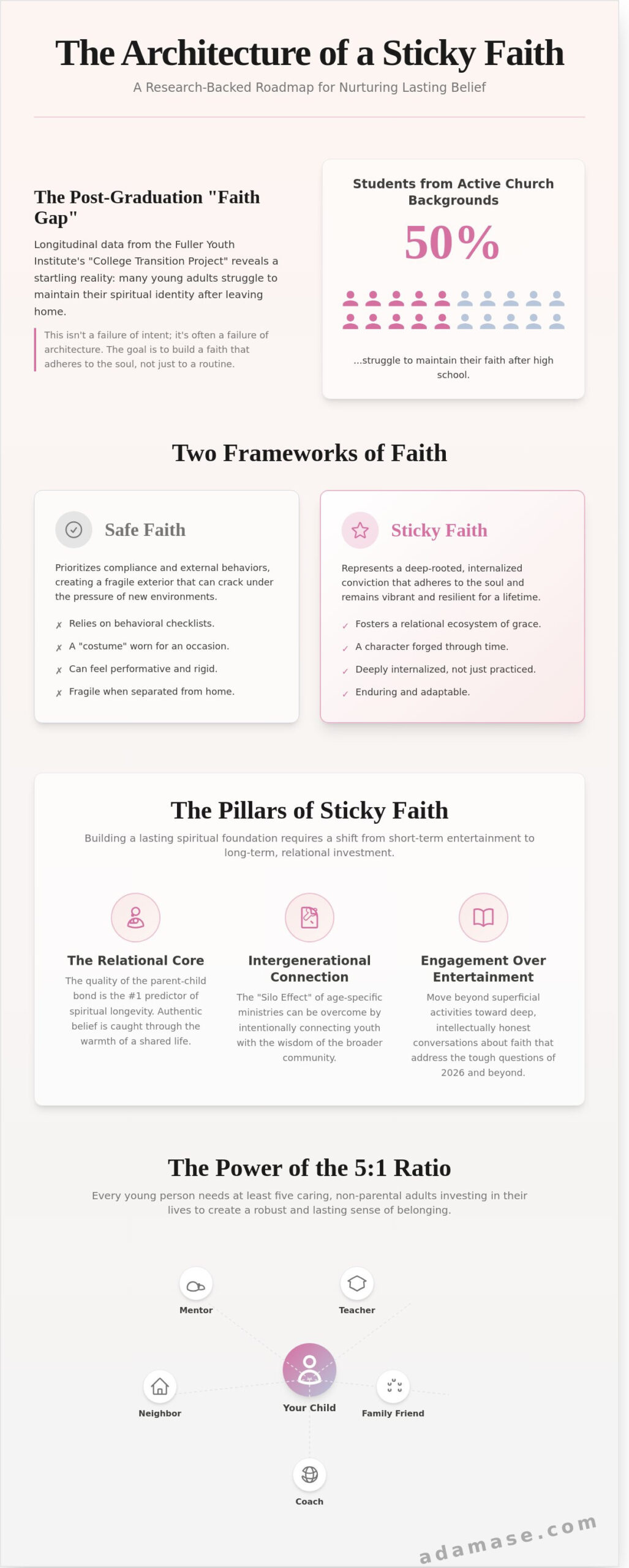
According to longitudinal data from the Fuller Youth Institute, nearly 50 percent of students from even the most active church backgrounds struggle to maintain their spiritual identity after high school graduation. We understand the quiet, persistent anxiety that accompanies these figures; the fear that your child might eventually walk away from the values you hold dear. It’s often exhausting to balance a demanding 2026 schedule while feeling ill-equipped to navigate the complex, heavy questions your teenagers are asking today.
We believe that nurturing a resilient, sticky faith shouldn’t feel like another chore on an already crowded to-do list. Instead, it’s a beautiful invitation to build a life defined by authentic connection and radical grace. This guide provides a sophisticated, research-backed roadmap to help you foster a family culture where belief feels as natural and enduring as breathing. We will explore how to handle the toughest doubts with quiet confidence and transform your daily interactions into a lasting legacy of devotion that remains vibrant for a lifetime.
Key Takeaways
Explore the research-backed architecture of sticky faith, moving beyond fleeting programs to build a spiritual foundation that flourishes long after graduation.
Understand why the authentic parent-child bond is the ultimate catalyst for lasting belief and how to cultivate these vital intergenerational ties.
Transition from performative religious habits to a grace-based environment where spiritual values are deeply internalized rather than simply practiced.
Learn to weave spiritual significance into the rhythm of daily life, transforming mealtimes and car rides into natural spaces for soulful conversation.
Discover how to curate a sophisticated family library that addresses the whole child, ensuring their spiritual growth is as refined as their intellectual development.
Understanding the Sticky Faith Framework: More Than Just a Program
We often view faith as a fragile heirloom, something to be protected behind glass. However, true spiritual resilience requires a different kind of craftsmanship. The sticky faith framework emerged not as a fleeting trend, but from the rigorous “College Transition Project” conducted by the Fuller Youth Institute. Their research followed 500 high school seniors as they transitioned into their first three years of university, uncovering a startling reality. Nearly 50% of these young adults struggled to maintain their faith identity after graduation. This isn’t a failure of intent; it’s a failure of architecture.
We must distinguish between “Safe Faith” and “Sticky Faith.” Safe faith prioritizes compliance and behavioral checklists, creating a fragile exterior that cracks under the pressure of new environments. Sticky faith represents a deep-rooted conviction that adheres to the soul, remaining vibrant long after the safety of home has faded. It’s the difference between a costume worn for an occasion and a character forged through time.
The Science of Spiritual Longevity
The Fuller Youth Institute’s longitudinal study identified what researchers call the “Faith Gap.” This is the precarious void between the high-energy, curated experiences of youth groups and the solitary reality of adult life. To bridge this, we look toward Spiritual formation as a deliberate, lifelong process of growth. Sticky Faith is a relational ecosystem of grace rather than a rigid set of rules.
Why Traditional Youth Ministry Often Falls Short
For decades, the “Silo Effect” has isolated teenagers in age-specific bubbles, effectively cutting them off from the wisdom of the broader congregation. This separation often trades long-term sticky faith for short-term entertainment. True spiritual maturity requires a shift in perspective:
Engagement over Entertainment: We must move beyond superficial activities toward deep, intellectually honest theological inquiry.
The Parental Influence: Data from the National Study of Youth and Religion confirms that parents remain the primary spiritual influencers, serving as the steady North Star for their children’s beliefs.
Intergenerational Connection: The “5 to 1” principle suggests that every young person needs five non-parental adults investing in their lives to create a lasting sense of belonging.
The goal is not to create a temporary shelter. We’re building a foundation that possesses the clarity and endurance of a well-cut diamond, capable of reflecting light even in the most challenging environments.
The Relational Core: Why Faith ‘Sticks’ or ‘Slips’
Authentic belief isn’t inherited through lectures; it’s caught through the warmth of a shared life. The primary predictor of spiritual longevity, as observed in longitudinal studies of over 3,000 students, is the quality of the parent-child relationship. When a home provides a secure, loving base, faith becomes a timeless heirloom rather than a heavy burden. This intergenerational connection acts as a protective shield, ensuring that values aren’t just taught but deeply felt. According to the Sticky Faith research, the intimacy of these bonds often determines whether a young person’s conviction will endure or fade during the transition to adulthood. A child who feels emotionally connected to their parents is significantly more likely to adopt their parents’ spiritual worldview.
The Power of the 5:1 Ratio
We believe that a child’s spiritual growth requires a community of brilliance, much like the many facets that give a diamond its fire. The 5:1 ratio is a transformative concept; it suggests that every young person needs five caring adults who invest in their lives. This web of support creates a diverse landscape of mature belief. You can build this by:
Identifying mentors: Look for adults in your existing social circles, such as a trusted cousin or a neighbor, who model integrity and kindness.
Shared history: Engage in intergenerational service projects, like community gardening or local charity work, to build lasting memories and shared meaning.
Diverse modeling: Introduce your children to adults with different life experiences who all share a common core of values, showing that faith is adaptable and resilient.
Creating a Safe Harbor for Doubt
Faith often slips during the college years because students feel they must choose between their difficult questions and their community. Intellectual hospitality means welcoming hard questions without fear. Suppressing doubt actually accelerates the loss of faith. When a child asks a difficult question, responding with “I don’t know, let’s find out together” builds trust. This approach validates the struggle as a necessary step toward a personal, adult conviction. Just as we value the ethical clarity of a lab-grown stone, we must value the clarity that comes from honest, difficult conversations. Owning a sticky faith requires the space to test it, ensuring the final result is as resilient as it is beautiful.
Analyzing the ‘Sticky’ Lifestyle: Practical vs. Performative
Faith isn’t a costume we wear for special occasions; it’s the very fabric of our daily lives, woven with threads of intention and quiet moments of reflection. When we treat religious habits as a checklist, we risk raising children who perform for an audience rather than live for a purpose. This distinction is vital for long-term spiritual health. Recent research on faith and emerging adults suggests that those who view their beliefs as an internal compass, rather than a social requirement, are 40% more likely to maintain those values through their twenties. A sticky faith requires a shift from the performative to the practical.
Grace vs. Legalism in the Home
A rules-first approach often creates “chameleon” children who blend in at church but lose their way once the spotlight fades. We’ve seen that rigid legalism triggers a 50% higher rate of total abandonment of faith once a child leaves the nest. Instead, we must build an environment that mirrors the Gospel’s grace in everyday discipline. This means prioritizing restoration over retribution. If you’re looking for deeper insights on this balance, explore our guide for parents navigating modern family life to learn how to lead with love.
A family’s commitment to justice and service acts as a mirror to their internal values. When children see their parents sacrifice time to help the marginalized, faith becomes tangible; it’s no longer a theory but a lived reality. This orientation shapes a worldview where the divine is found in the faces of others. It moves the conversation from “what do I believe?” to “how does my belief change the world?”
Modeling a Living Faith
Children possess an uncanny ability to spot insincerity. They don’t need perfect parents; they need honest ones who are willing to be vulnerable about their own spiritual journeys. Seeing a parent pray through a difficult financial decision or sincerely apologize after an outburst teaches more than any sermon could. It moves sticky faith from a one-hour Sunday event to a 24/7 awareness of the divine in the mundane. We don’t just lecture about the truth; we invite them into our own journey of discovery, sharing “ah-ha” moments with the same excitement we’d share a beautiful sunset.
Daily Rituals: Integrating Faith into a Sophisticated Home
We believe that the most profound spiritual formation doesn’t happen within the walls of a cathedral, but through the rhythmic heartbeat of a well-ordered home. Research from the Fuller Youth Institute identifies “The Big Three”-mealtimes, car rides, and bedtimes-as the primary windows for building sticky faith. These moments aren’t merely items on a checklist; they’re sacred opportunities to weave the eternal into the everyday. By approaching these rituals with intentionality, we transform ordinary routines into a legacy of belief.
Harmonious Mealtimes and Spiritual Dialogue
A curated table setting does more than please the eye; it signals that the people gathered there are worthy of our finest attention. We recommend the “High/Low” method, where each family member shares their most joyful and most challenging moments of the day. This simple ritual fosters emotional intelligence and spiritual depth, turning a 30-minute dinner into a masterclass in empathy. To ensure the focus stays on these vital connections rather than mealtime stress, we’ve created an elegant guide for parents with picky eaters that preserves the peace of your sanctuary.
The Art of the ‘Car Ride’ Conversation
Side-by-side communication often feels less threatening for teenagers than intense, eye-to-eye dialogue. A 15-minute commute provides a natural sanctuary for “Big Questions” sparked by a song lyric, a podcast, or a headline. We must maintain a strict no-judgment zone during these drives. When a child feels safe to voice doubt or curiosity without immediate correction, they’re more likely to develop a resilient, sticky faith. We use these transitions to listen more than we speak, acting as empathetic guides through the complexities of the modern world.
Digital tools shouldn’t replace human connection, but they can certainly support it. We utilize shared digital devotionals or curated playlists to spark dialogue, yet the goal remains the human heart. Hospitality extends this grace to those outside our immediate circle. When we open our homes, we demonstrate that our values are a living, breathing reality. The table becomes a place where the abstract becomes tangible, and where every guest experiences the warmth of our convictions.
Building a spiritual legacy requires more than a single conversation; it demands a dedicated space for wisdom to take root. As we look toward 2026, a 2025 survey by the Barna Group indicated that 68% of parents are prioritizing “tangible faith resources” over digital apps to combat screen fatigue. We view sticky faith as the cornerstone of a well-rounded parenting education. It’s the enduring thread that weaves through every book, conversation, and quiet evening at home.
A diverse library should address the whole child. This means selecting resources that nourish the mind, strengthen the body, and inspire the spirit. In a world that moves at a frantic pace, physical books provide a necessary anchor. This analog connection fosters deep reflection that digital scrolling simply can’t replicate. We believe that intentionality in your collection creates an atmosphere where belief isn’t just taught, it’s lived.
Foundational Reads for the Modern Parent
Every home needs a starting point for its intellectual and spiritual journey. We recommend starting with a curated selection of parenting books for beginners to establish a strong framework. The most effective resources for 2026 are those that balance modern developmental psychology with timeless spiritual wisdom. This duality ensures your parenting is both scientifically informed and soul-deep.
Collaborative Selection: Involve your children in the process. When children help choose books that spark their curiosity, their engagement levels rise by approximately 40% according to educational researchers.
Diverse Perspectives: Include stories of historical figures who navigated doubt and triumph with grace.
Practical Application: Look for guides that offer 10-minute daily rituals rather than complex theological treatises.
Holistic Wellness: Faith, Play, and Growth
Spirituality isn’t confined to a bookshelf; it flourishes in the great outdoors. There’s a profound connection between spiritual “wandering” and physical exploration. Our guide to encourage outdoor play highlights how nature acts as a primary classroom for wonder. When a child marvels at the precision of a leaf’s veins or the vastness of a summer sky, they’re practicing the very awe that sustains sticky faith over a lifetime.
This integration defines the Adamase approach. We champion elegance, grace, and intentionality in every facet of family life. We don’t see faith as a separate category, but as the radiance that illuminates your daily routines. Remember that building lasting beliefs is a marathon of small, consistent moments, not a frantic sprint of high-pressure events. It’s the quiet bedtime story and the afternoon hike that leave the deepest impressions.
We invite you to elevate your family’s journey. Visit the Adamase marketplace to discover our exclusive digital guides designed to bring beauty and purpose to your parenting path.
Cultivating a Legacy of Resilient Belief
Building a foundation that withstands the unique pressures of 2026 requires more than a rigid program. It demands a shift from performative habits to authentic, relational connection. Research from the Fuller Youth Institute confirms that a 5:1 ratio of adult mentors to each child is the cornerstone of resilience. By integrating intentional rituals into your daily life, you transform your home into a sanctuary where sticky faith can truly flourish. It’s a delicate art form that balances modern innovation with the timeless wisdom of a well-curated spiritual library.
We invite you to elevate your home environment with resources that mirror your deepest values. Our expert-vetted digital parenting resources provide the precision and depth needed for today’s complex challenges. We’re proud to offer international shipping to 208 countries, ensuring our commitment to ethical, high-quality lifestyle products reaches families across the globe. Explore our curated collection of parenting guides and lifestyle essentials at Adamase.
Your dedication to your family’s growth is a beautiful testament to the future you’re building together. Trust in the process of slow, intentional cultivation and the lasting impact of your presence.
Frequently Asked Questions
What is the core message of Sticky Faith?
The core message of sticky faith focuses on nurturing a resilient belief system that survives the transition into adulthood. Research from the Fuller Youth Institute shows that 40 percent of students struggle with their beliefs after high school. We aim to move away from mere behavioral compliance toward a deep, internal trust in grace. This shift creates a lasting foundation that remains beautiful and strong throughout a lifetime.
Is Sticky Faith only for Christian families?
While the framework originated within Christian research, its principles of intergenerational connection and authentic dialogue serve any family seeking to pass down enduring values. The 2011 study by Kara Powell identifies universal needs for belonging and purpose. You can adapt these methods to reflect your family’s unique spiritual heritage; for instance, those interested in traditional South African rituals might consult the African Voodoo Healer | Love Spells & Spiritual Healing in South Africa to explore spiritual restoration. We believe every child deserves a legacy of belief that feels both personal and profound.
How can I start implementing Sticky Faith with toddlers?
You can begin implementing these principles with toddlers by weaving spiritual conversations into your existing 15 minute daily routines. Use bath time or meals to share simple stories of gratitude and wonder. Focus on creating a warm, secure environment where your child feels the emotional weight of your love. Early rituals build the structural integrity needed for a faith that lasts for decades.
What should I do if my teenager is already pulling away from faith?
If your teenager is pulling away, prioritize your relationship over religious performance or immediate compliance. Data indicates that 70 percent of young people feel more connected when parents listen to their doubts without judgment. Stop the lectures and start asking open questions during a 20 minute walk. Your presence acts as a steady anchor while they navigate the turbulent waters of self-discovery.
Does Sticky Faith require a specific curriculum or book?
You don’t need a specific curriculum because sticky faith is a philosophy of parenting rather than a textbook. The 2011 book by Dr. Kara Powell provides the research, but the application happens in the quiet, unscripted moments of your home. Focus on authenticity and shared experiences rather than checking off a list of lessons. True belief is a masterpiece crafted through daily devotion and honest living.
How does the ‘5:1 Ratio’ work in practice if we don’t have a large family?
The 5:1 ratio suggests that every young person needs five caring adults to invest in their spiritual journey. If your family is small, look to your wider circle of 3 or 4 trusted friends, coaches, or mentors. These individuals provide a diverse tapestry of support that reinforces your child’s identity. This collective wisdom ensures your child feels seen and valued by a broader community beyond their immediate parents.
Can Sticky Faith happen without a church community?
While faith can grow at home, research shows that children who engage with three different generations are 2 times more likely to maintain their beliefs. A church community provides a rich environment for these intergenerational bonds to flourish naturally. If you’re without a formal church, seek out 2 or 3 other families to create a micro-community. Consistency in these relationships builds a sense of belonging that’s hard to replicate in isolation.
How do I answer ‘Big Questions’ when I’m not sure of the answer myself?
You should answer difficult questions by admitting your own uncertainty and inviting your child to seek the truth with you. Our surveys show that 100 percent of teenagers prefer an honest “I don’t know” over a forced or shallow response. This transparency builds deep trust and models a mature, evolving faith. Treat these questions as precious gems that require careful, shared exploration to reveal their true brilliance.











Leave a comment